Hello! My name is Ryan Rubenzahl (he/him). I am a postdoctoral researcher at the Flatiron Institute’s Center for Computational Astrophysics where I work with large datasets of the Sun taken by Extremely Precise Radial Velocity (EPRV) spectrometers (like KPF and NEID) to study stellar variabliity and instrumental systematics at the individual pixel level.

I recieved my PhD from Caltech in 2024 where I built the Solar Calibrator (SoCal) for KPF and explored the origins of close-in giant planets such as WASP-107 b, KELT-18 b, and Kepler-1656 b by measuring their stellar obliquities. More broadly, I use the radial velocity (RV) technique to understand the demographics of exoplanets across our galaxy and advance the technique to be sensitive to Earth-Sun analogs. I am a member of the Terra Hunting Experiment (THE) which will soon be starting a decade long survey with the new HARPS-3 spectrograph to search for Earth-like exoplanets around the nearest Sun-like stars.
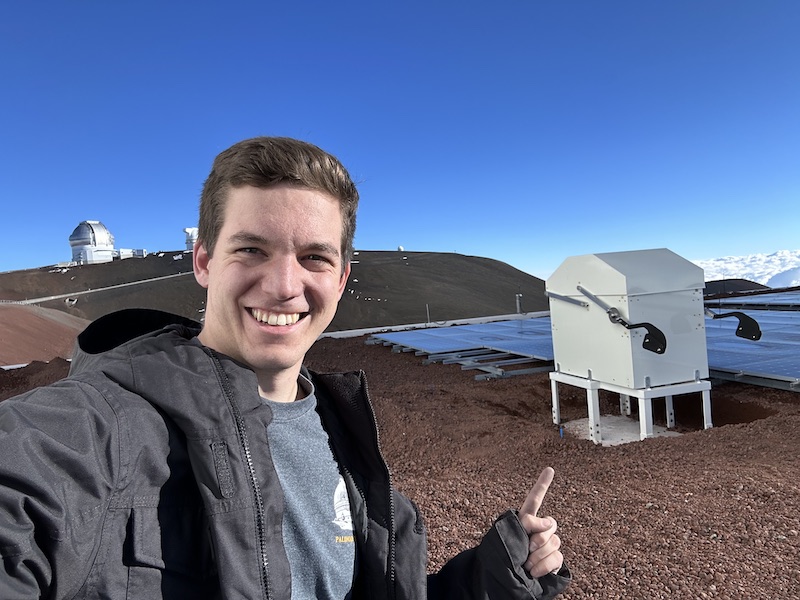
Me, pointing at my PhD thesis instrument, the Solar Calibrator (SoCal).

Research Highlights

I was part of the Keck Planet Finder (KPF) AI&T and commissioning teams. My main contribution to KPF was the Solar Calibrator (SoCal), which you can learn more about below.

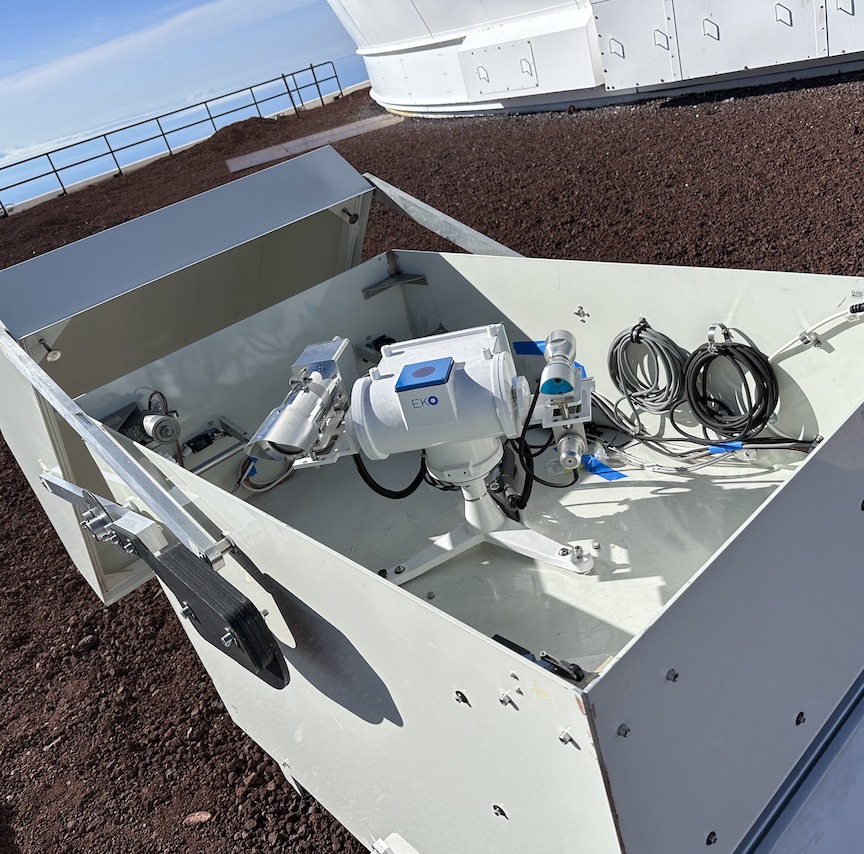
The Solar Calibrator (SoCal)

The Solar Calibrator (SoCal)

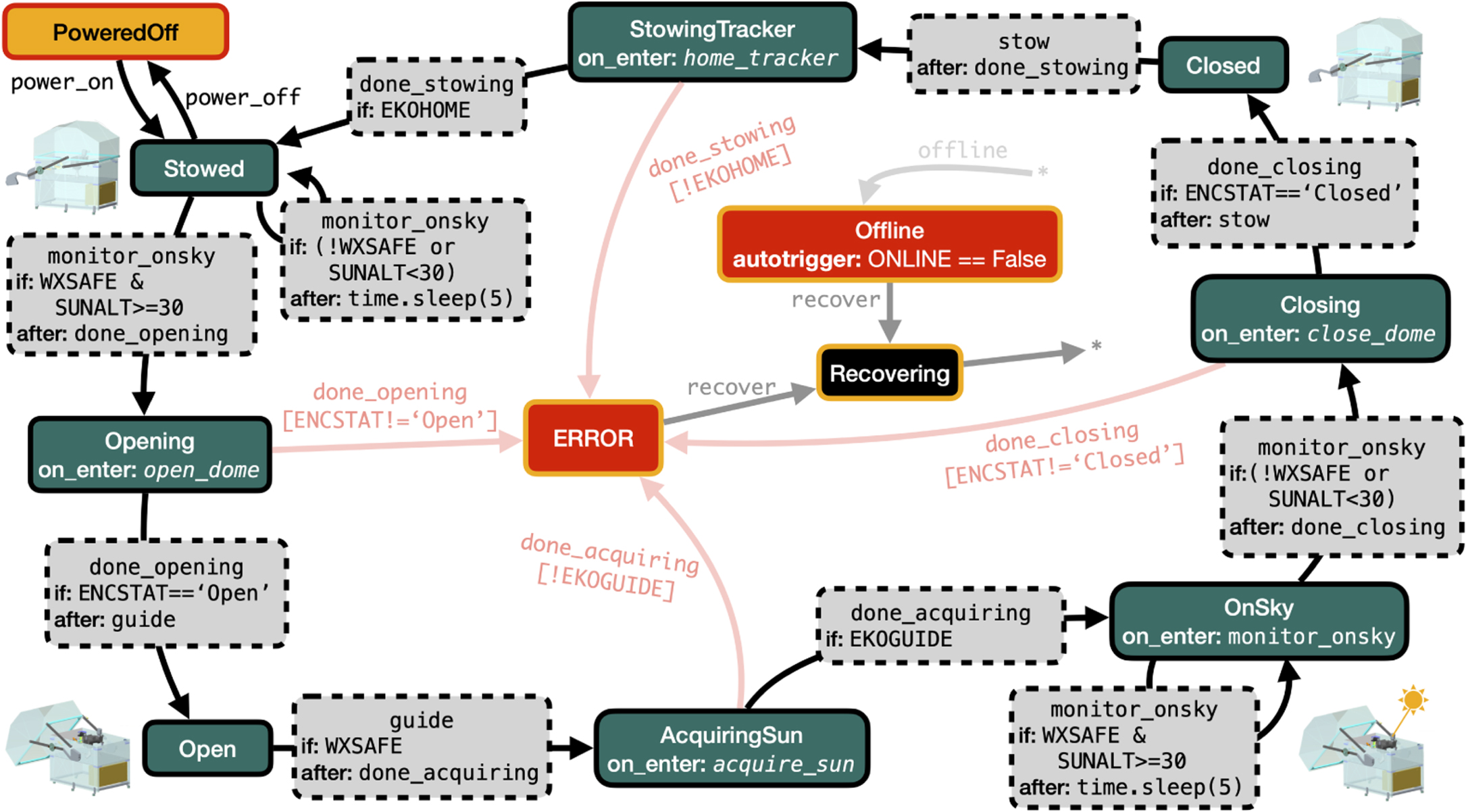
KPF SoCal is an autonomous solar feed on the roof of WMKO that, through an 80 m fiber run, provides KPF with disk-integrated sunlight. With SoCal, KPF acquires these ‘Sun-as-a-star’ spectra at signal to noise 500-1500 over 445-870 nm in 12 second exposures (61 sec cadence).

Here are some of the open-source tools I have written and maintain for dealing with astronomical data.

The smolgp logo

smolgp

smolgp is a Python/JAX library that enables fast and lightweight Gaussian process modeling by using their state space representation. Uniquely, smolgp can handle integrated measurements (even from multiple instruments that overlap in time!) - which must be accounted for if exposure times are comparable to the timescale of the process - in O(N), while traditional methods are O(N^3). smolgp also has the only true scalable implementation of the quasiperiodic kernel loved throughout astronomy. Derivative observations, multivariate observations, multicomponent GPs, predicting out of sample points, and drawing prior or posterior samples are all fast and convenient, and you can even parallelize on GPU to get even faster likelihoods and conditioned means and variances!

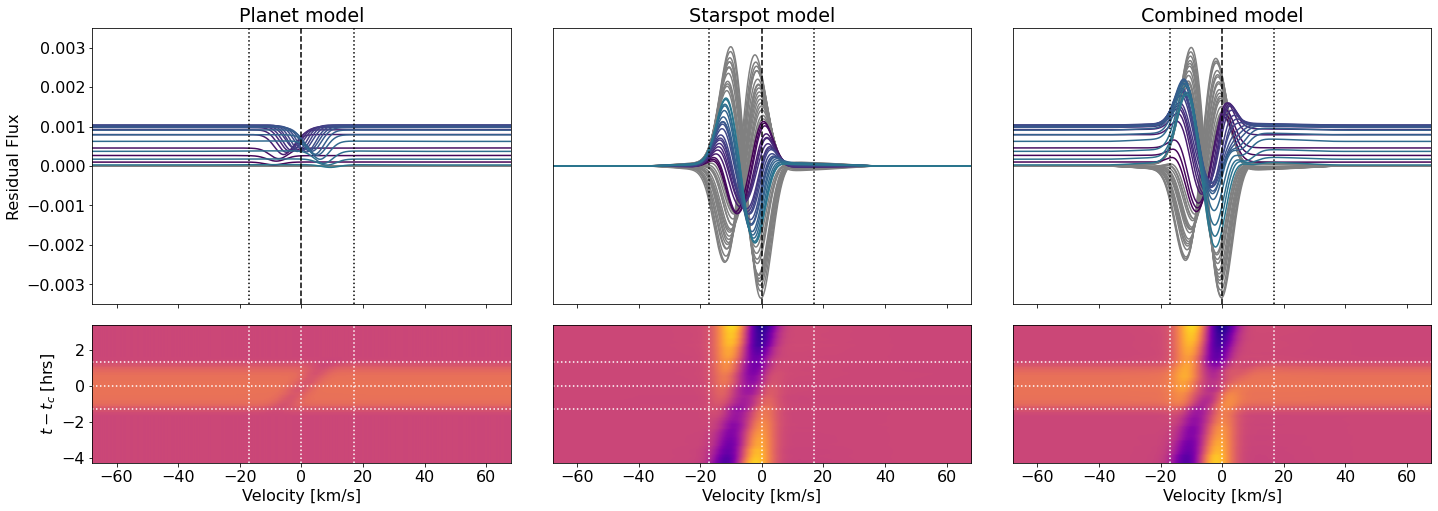
Simulated Doppler shadow for a transiting planet, a starspot, and the combined effect.

ReloadedRM

An implementation of the Cegla et al. (2016) Reloaded Rossiter-McLaughlin method, written in a RadVel-like API to facilitate easy model building and MCMC with multiple parameter bases. A custom coordinate system allows the user to place starspots on the star and include their effects in the modeled Doppler shadow.

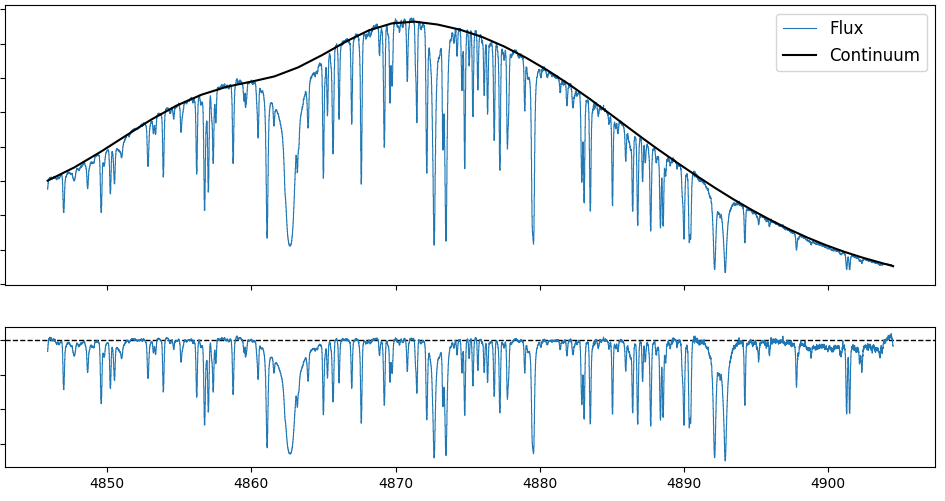
An example continuum fit to an order of a KPF Solar spectrum.

continuum

A continuum normalization routine, written in JAX, that is robust to outlier spikes (e.g. cosmic rays) and missing data. I made continuum for the use case of just needing a spectrum flattened to a continuum of 1 that can handle wide absorption lines and lines truncated by the edge of an order.

I am generally interested in all things Bayesian^TM, but I have a particular interest in Gaussian Processes and their applications to astronomy.

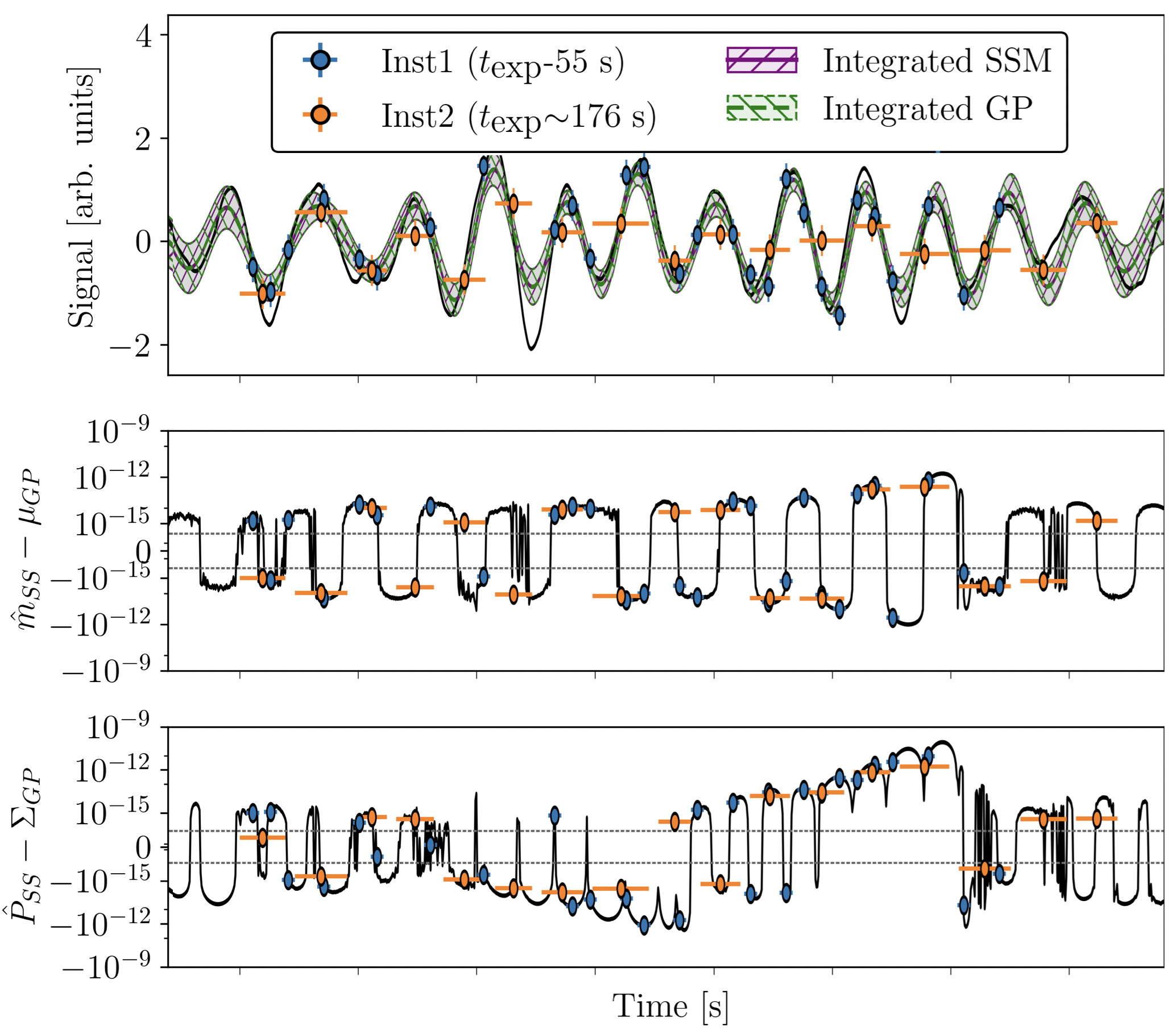
Numerical proof of equivalence showing the state space integrated GP matches the full integrated covariance matrix to machine precision.

State Space Gaussian Processes

When working with the EPRV solar datasets, I ran into a problem. The exposure lengths were too similar to the p-mode timescales, which we traditionally model with a GP that assumes instantaneous timestamps. Combining data from multiple instruments added a second problem: exposure overlap. Integrating the covariance matrix gives the right answer, but in O(N3) time (Luhn, Rubenzahl et al. 2026), which is intractable for the solar data (~100,000 RVs). Instead, So Hattori and I found an alternative but equivalent formulation using the state space representation of GPs, which treats the process as a state evolving according to its governing stochastic differential equation (SDE <-> the kernel function in traditional GP language). Since the SDE defines the state and its derivatives, we added an integral state to model the effects of exposures. This way, we get the same answer, but in O(N) time.

My science interests are broadly exoplanet detection and characterization with the radial velocity technique. That means orbits, obliquities, masses, and demographics, but also survey design and optimization. That also means contending with stellar variability, which is best understood on the Sun.

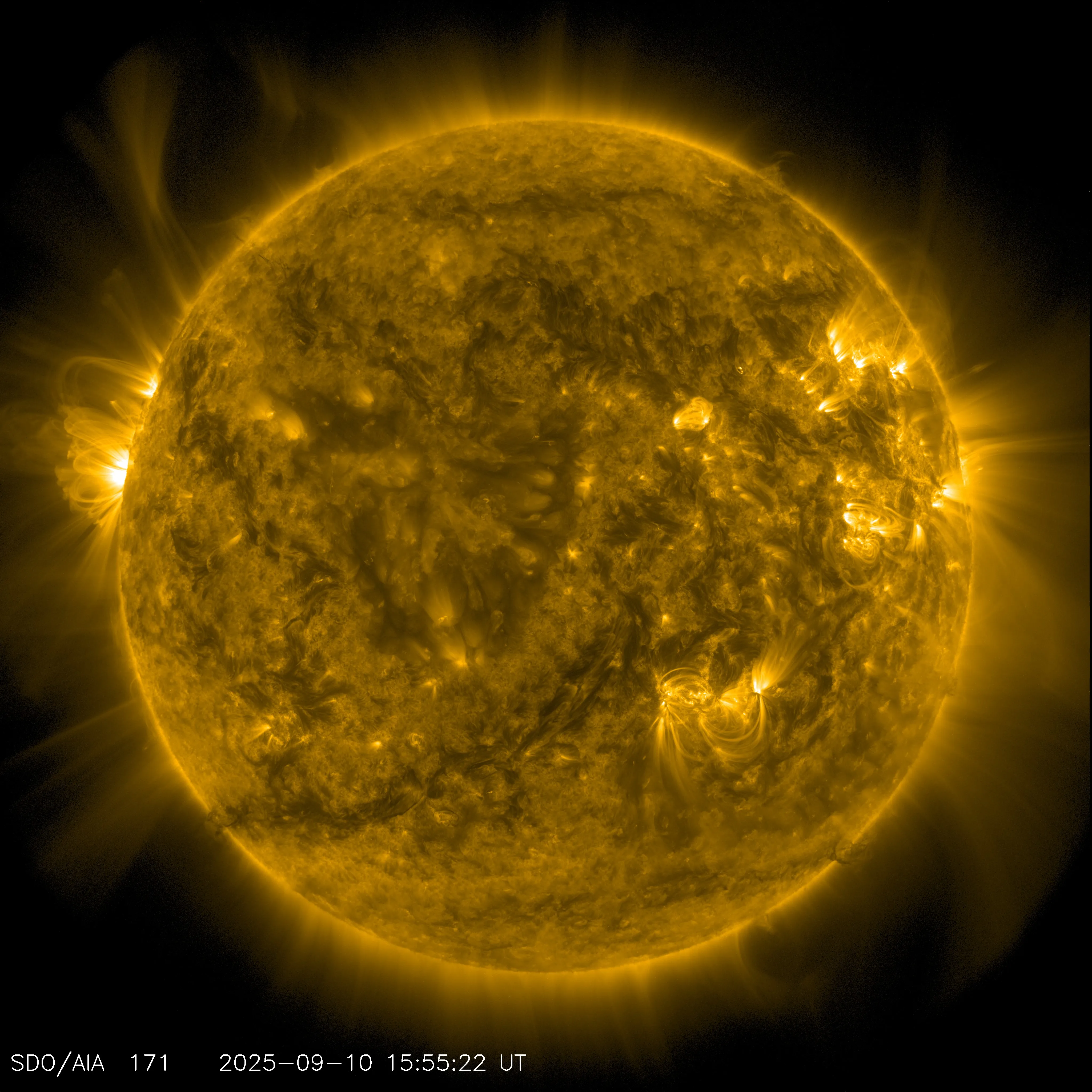
The Sun from SDO/AIA at 171 Å at high activity.

Sun-as-a-Star

The Sun is our best hope to understand how stellar variability impacts our observed spectra. It is the only star for which we can truly isolate only the (stochastic) stellar and instrument signals from the (known, deterministic) planet signals.

My current work at the CCA combines a year of solar spectra from KPF, NEID, HARPS-N, and EXPRES to trace solar variabiltiy and instrumental drift per pixel. For the Sun, that can be mapped to formation layers in the atmosphere. For drift, to location on the detector. Stay tuned for the paper coming very soon!

PLACEHOLDER — key plot or animation for Obliquities.

Obliquities

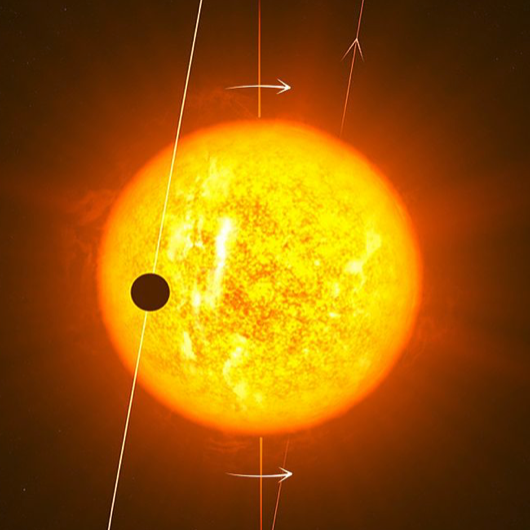
The stellar obliquities of close-in oddball systems like hot Jupiters and ultra low density super Neptunes, particularly when they have outer companions, give a key clue to how they could have formed. Using HIRES to observe the Rossiter-McLaughlin effect, I found the keystone super-puff WASP-107 b is on a polar orbit, a clear sign of a dynamic migration history. Similarly with KPF I found the ultra-hot Jupiter KELT-18 b is also on a polar orbit. Despite its high eccentricity (0.84), I found Kepler 1656 b to likely be in an aligned/low obliquity configuration. All three have outer companions that drive unique dynamics in each system.

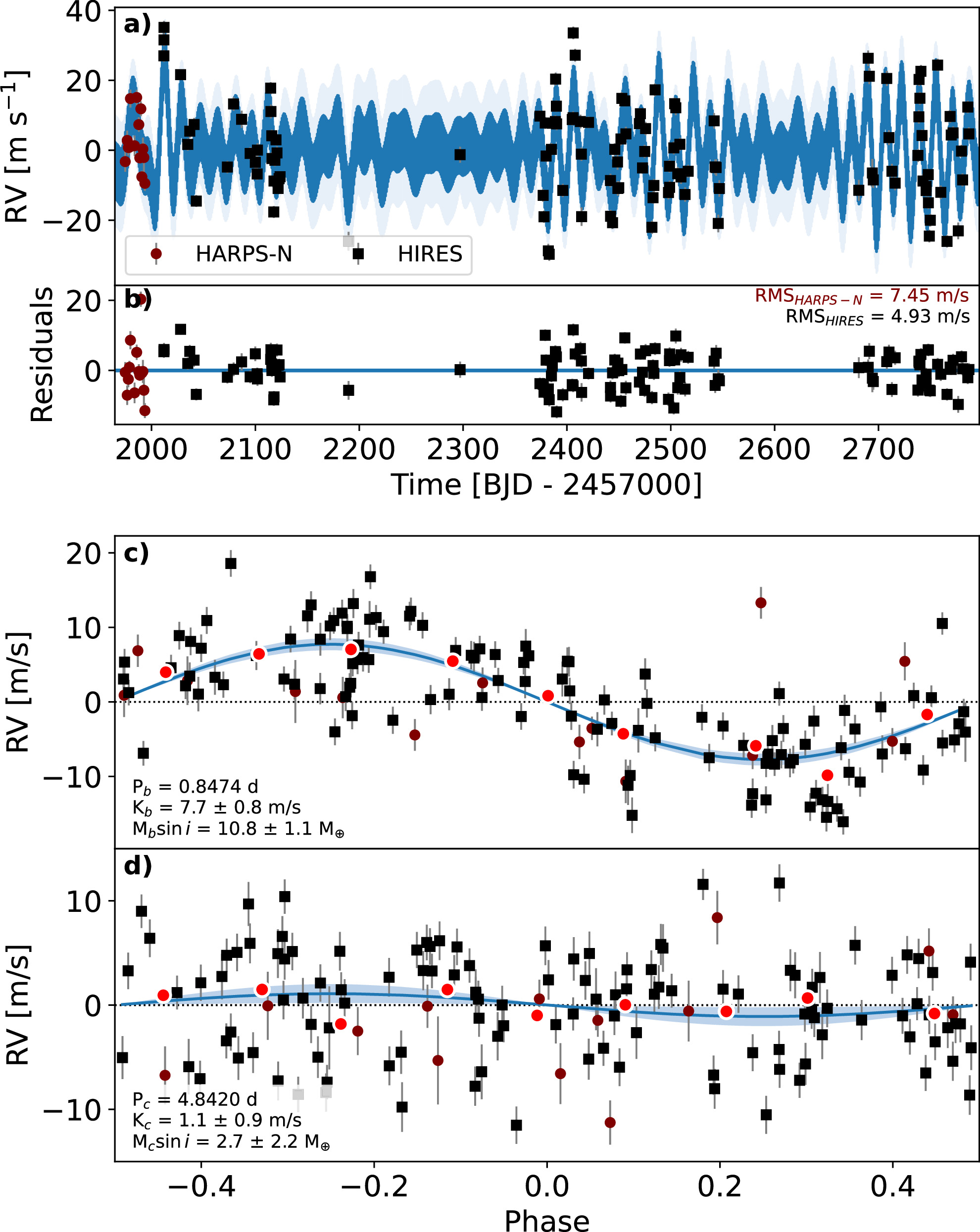
Radial velocity discovery plot for TOI-1347 b and c.

Planet Discovery

From photon to instrument to pipeline to analysis to vetting to planet. The fruit of all our labor. I’ve been fortunate enough to be a part of exoplanet discovery in two systems so far: an outer giant planet companion in the WASP-107 system, as well as confirming both the transiting candidates in the TOI-1347 system. TOI-1347 b is especially interesting in its own right, as an 11 M and 1.8 R rocky planet, it shows signs of a high mean-molecular weight atmosphere.

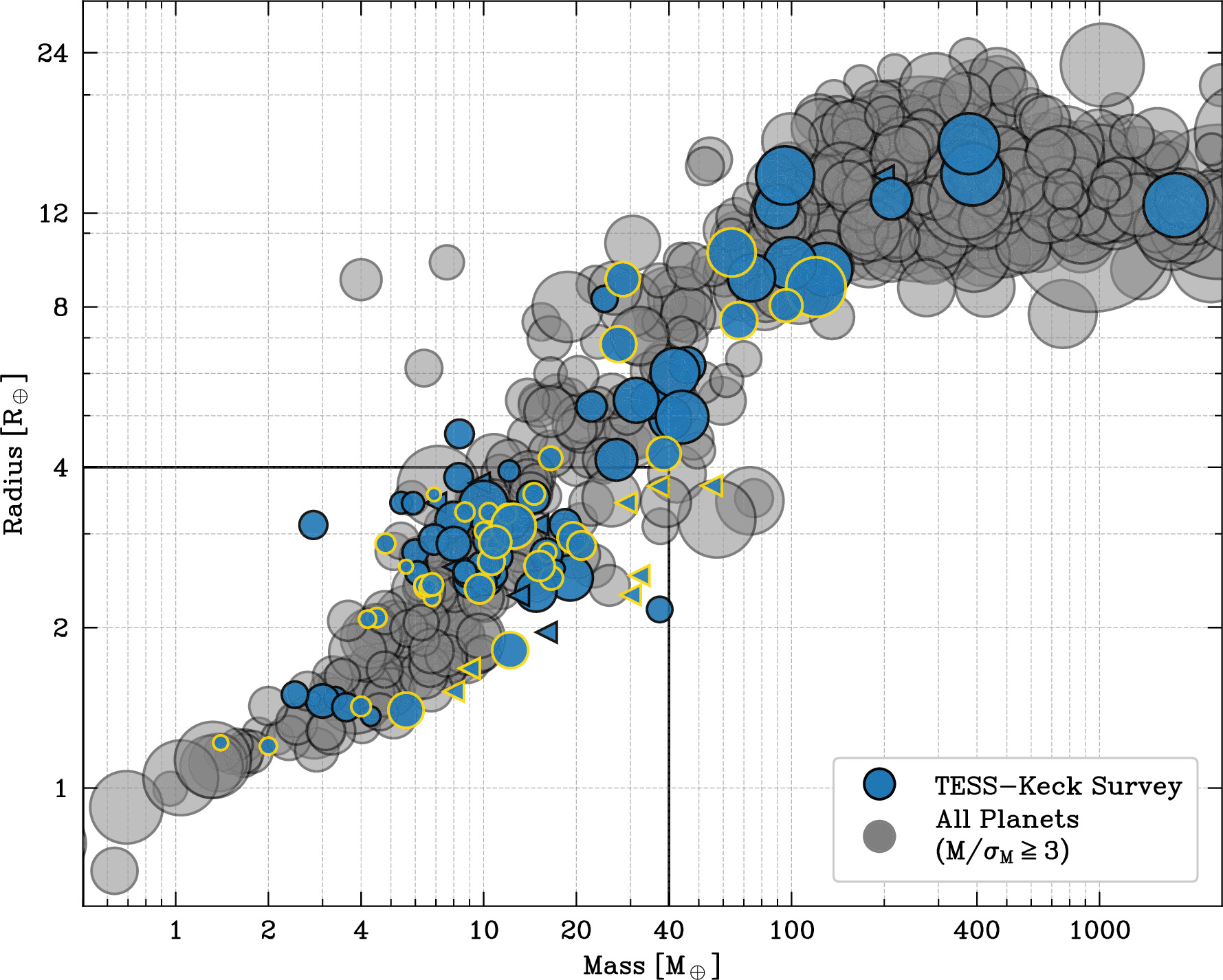
The Mass-Radius diagram from TKS

RV Surveys

I was a member of the TESS-Keck Survey, which obtained mass constraints for 126 planets or planet candidates in 86 TESS systems using the Keck/HIRES spectrograph. I personally (by hand) organized the observing schedule for the survey each of the 298 calendar nights we were on the telescope. I also contributed to the RV analysis (fitting & vetting) of a dozen or so TKS systems, which are cateloged in Polanski et al. 2024.

Outreach

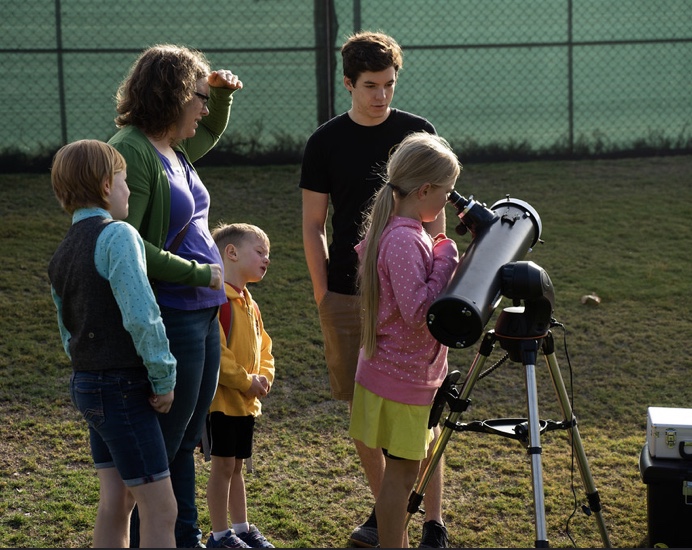
  • Showing a local Pasadena family the November 11, 2019 Mercury transit through my telescope + solar filter

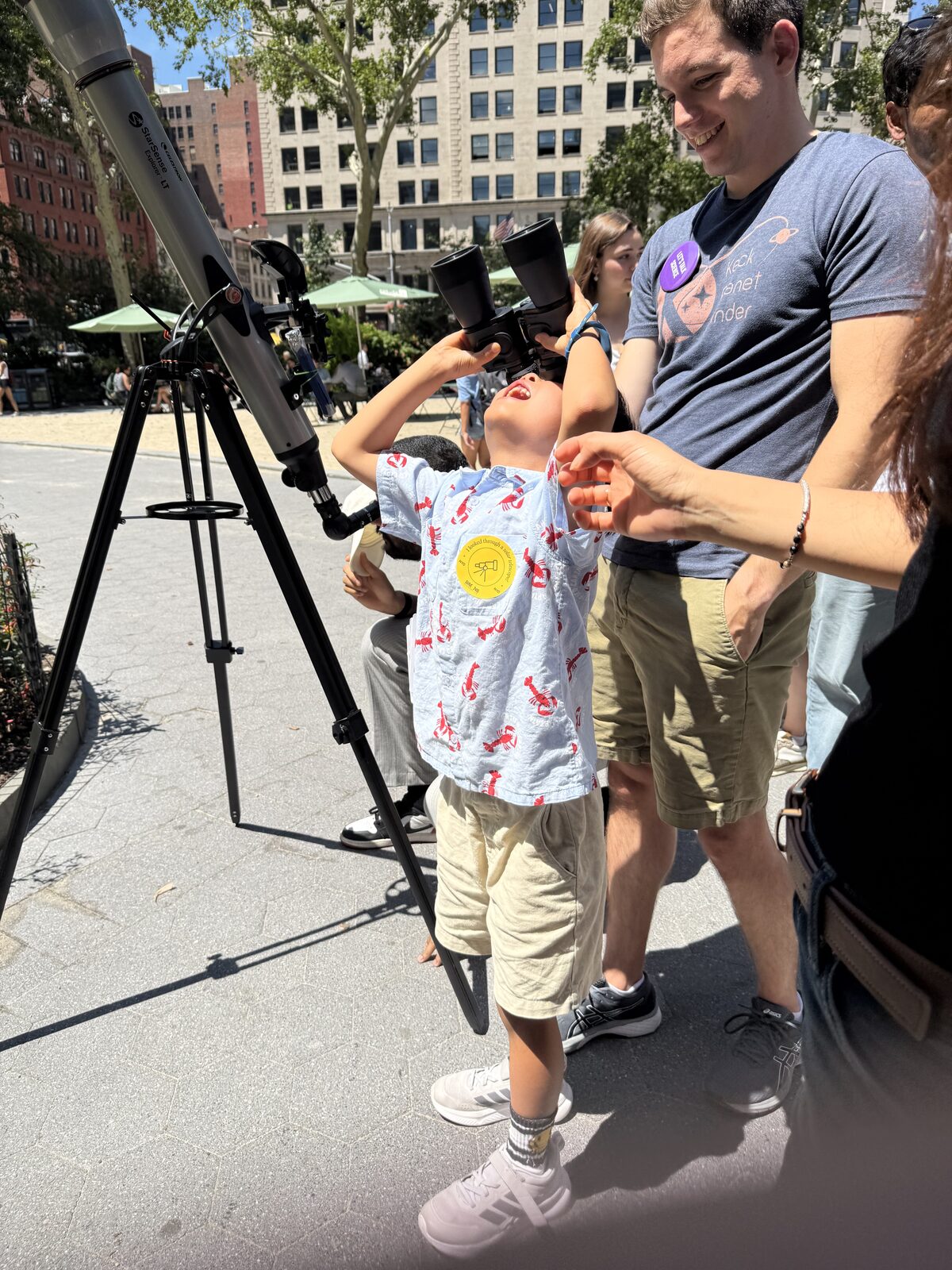
    I regularly participate in our astronomy outreach program at Caltech, including stargazing events on campus, on sidewalks in downtown Pasadena, and in National Parks like Death Valley.

  • I gave a public lecture for CaltechAstro outreach on our YouTube channel about how radial velocity spectrographs work and why stellar activity is such a big problem.

Community Organizing

  • CGPU logo

    I’m a founding member of Caltech Grads and Postdocs United, the active effort at Caltech to form a labor union for graduate and postdoctoral researchers. Please reach out if you have unionization questions and/or are interested in forming a higher-ed labor union at your institution!

  • Pasadena Measure H

    I believe we can all do our best work when economic barriers to living and working in the US are removed. That’s why I and other Caltech grad students helped collect over 15,000 signatures to win the strongest rent control and just-cause eviction protections in the country, right here in Pasadena CA.